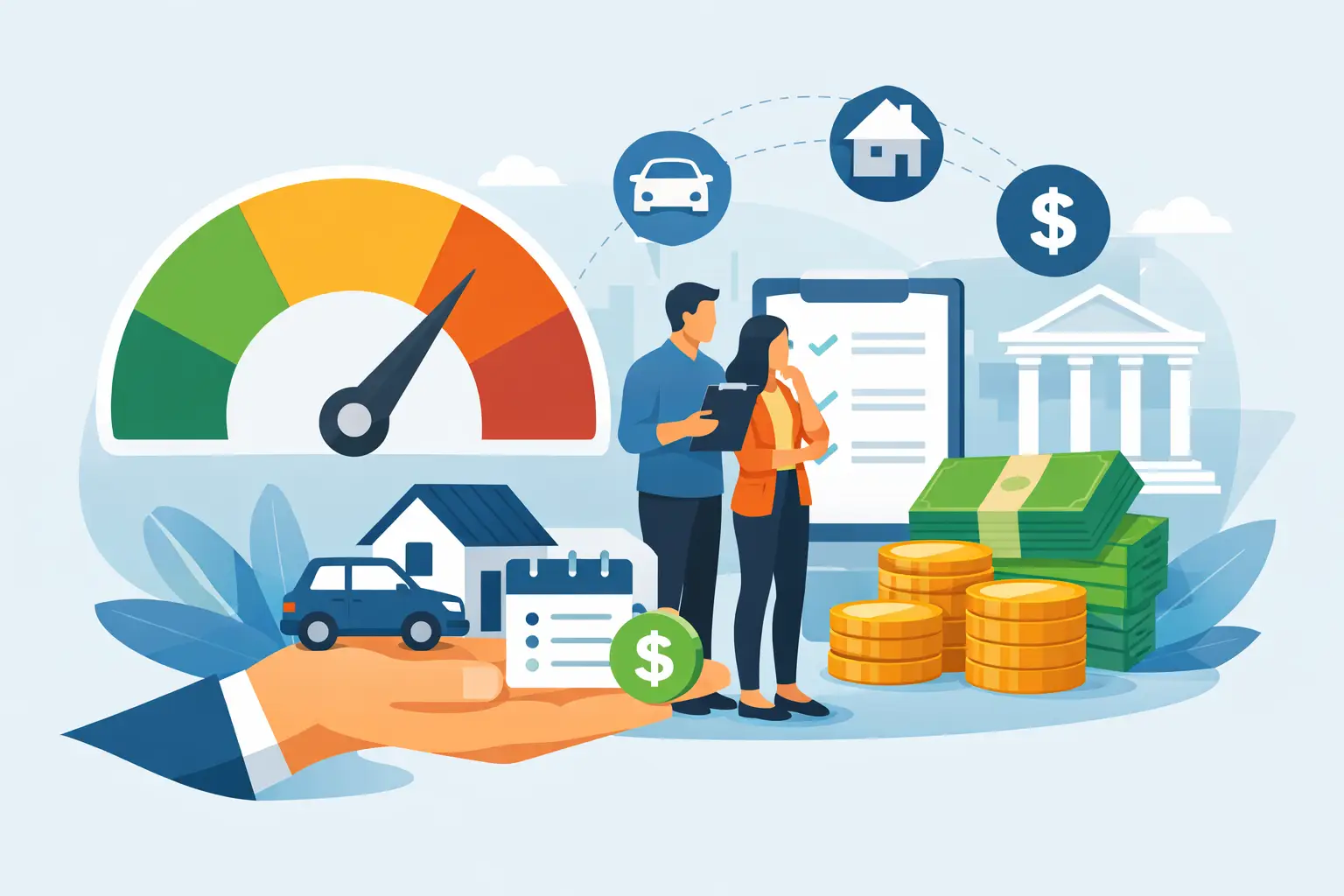
A car repair cannot always wait for your credit to improve. If you are asking what credit score is needed for installment loans, the direct answer is that there is no single minimum score. Some lenders focus on borrowers with good credit, while others consider applicants with fair, poor, limited, or no established credit history.
Your score can affect whether you qualify, how much you may be offered, your repayment term, and the annual percentage rate (APR) attached to the loan. But credit is only one part of an application. Income, current debts, banking history, and your ability to repay can matter just as much.
What Credit Score Is Needed for Installment Loans?
Installment loans are loans repaid through scheduled payments over a set period. Depending on the lender and the loan type, terms may run from a few months to several years. Personal installment loans are commonly used for unexpected bills, medical costs, repairs, moving expenses, or other immediate needs.
Many traditional banks and credit unions prefer applicants with scores in the good-credit range, often 670 or higher. Online lenders may accept lower scores, and some lenders do not use a strict credit-score cutoff at all. A score below 670 does not automatically mean you cannot get an installment loan. It usually means your loan options may be more limited or more expensive.
These ranges provide a general picture, not a promise of approval:
- Excellent credit: 740 and above. Borrowers may have access to more lenders, higher loan amounts, and lower rates when other application details are strong.
- Good credit: 670 to 739. This range can qualify for many standard personal loan offers, though rates and terms still vary.
- Fair credit: 580 to 669. Approval may be available, but lenders may offer smaller amounts, shorter terms, or higher APRs.
- Poor credit: below 580. Some lenders work with bad-credit borrowers, especially when income and bank account information support the application. Costs can be higher, so reviewing the full repayment amount is essential.
- No credit or thin credit file. A limited history is different from bad credit. Some lenders use alternative information, such as income and account activity, to evaluate applicants.
A lender may also use a version of your score that differs from the one you see in a credit-monitoring app. That is another reason not to assume a single number decides your outcome.
Why Your Score Is Not the Only Approval Factor
A credit score helps lenders estimate risk based on your past borrowing behavior. It does not show the complete picture of your current finances. Someone with a lower score and steady income may look more prepared to make payments than someone with a higher score and heavy monthly debt.
Lenders commonly review your income, employment or benefit income, recurring obligations, debt-to-income ratio, requested loan amount, and checking account details. They may also consider recent loan applications, payment history, bankruptcies, collections, or charge-offs.
For small-dollar installment loans, the amount you request matters. A borrower may have a better chance of qualifying for a smaller amount that fits comfortably within their budget than for the maximum amount available. Request what you need, not simply the largest number you see.
Soft Checks vs. Hard Credit Inquiries
Some lenders or loan marketplaces may begin with a soft credit inquiry when checking potential eligibility. A soft inquiry generally does not affect your credit score. If you move forward with a specific lender, that lender may perform a hard credit inquiry before finalizing the loan. Hard inquiries can have a temporary effect on your score.
Read the application disclosures so you understand what type of credit check may be used. You should also know that receiving an offer is not the same as accepting a loan. Review the terms before signing an agreement.
What to Expect With Fair or Bad Credit
If your credit is less than perfect, an installment loan can still be possible. The trade-off is often cost. Lenders may charge higher APRs to account for the increased risk of lending to borrowers with past credit problems or limited credit history.
APR includes interest and may include certain fees, making it a more useful comparison point than the interest rate alone. A lower monthly payment can look easier to manage, but a longer term may mean you pay more in total interest. On the other hand, a shorter term can reduce total cost while increasing the payment due each month.
Before accepting an offer, check the loan amount, APR, finance charge, payment schedule, total of payments, late-payment rules, and whether there is a prepayment penalty. Do not rely only on a headline that says you are approved. The contract details tell you what the loan will actually cost.
How to Improve Your Chances of Getting an Installment Loan
You do not need to wait for a perfect score to apply, but a few practical steps can strengthen your application. First, check that your personal information is accurate. A wrong address, mismatched name, or outdated employer information can slow verification.
Next, use a loan amount and payment that make sense for your budget. Review your upcoming rent, utilities, food, transportation, and existing debt payments before committing. If the new payment would leave no room for normal expenses, taking the loan could create a more difficult problem later.
Having documents ready can also help. Depending on the lender, you may need a government-issued ID, proof of income, an active checking account, an email address, and a working phone number. Providing complete and accurate information helps lenders make a decision faster.
Avoid submitting applications with information you cannot verify. Lenders may decline applications when income, identity, or account information cannot be confirmed. Accuracy is more useful than trying to make an application look stronger than it is.
If You Are Declined
A decline from one lender does not mean every lender will say no. Lenders use different requirements, loan sizes, and underwriting methods. You may qualify elsewhere, especially if another lender places more weight on current income than on a past credit issue.
Still, do not repeatedly apply without a plan. Too many hard inquiries in a short period can be a concern, and accepting an expensive loan just because it is available can strain your finances. Consider requesting a smaller amount, paying down an existing balance, correcting credit-report errors, or waiting until you have more stable income if the expense can be delayed.
Compare Offers Based on the Payment You Can Handle
Fast funding can be useful when an urgent expense hits, but speed should not replace careful review. A lender may advertise quick decisions and rapid deposit times, yet actual funding can depend on verification, lender processing, your bank, and the time of day you accept an offer.
When comparing installment loan options, focus on the full payment obligation. Ask yourself whether you can make every scheduled payment on time without skipping essentials or depending on another loan. Also check whether the lender is licensed where required and whether the agreement clearly explains your responsibilities.
For borrowers who need to explore options quickly, an online lending marketplace such as Yup Loans may connect applicants with lending partners that consider a range of credit profiles. Connection to a lender is not a guarantee of approval, and each lender sets its own eligibility standards and terms.
Your credit score matters, but it is not the final word on installment loan eligibility. The best next move is to request only what you can repay, compare every offer carefully, and choose a payment schedule that solves today’s problem without creating a larger one next month.