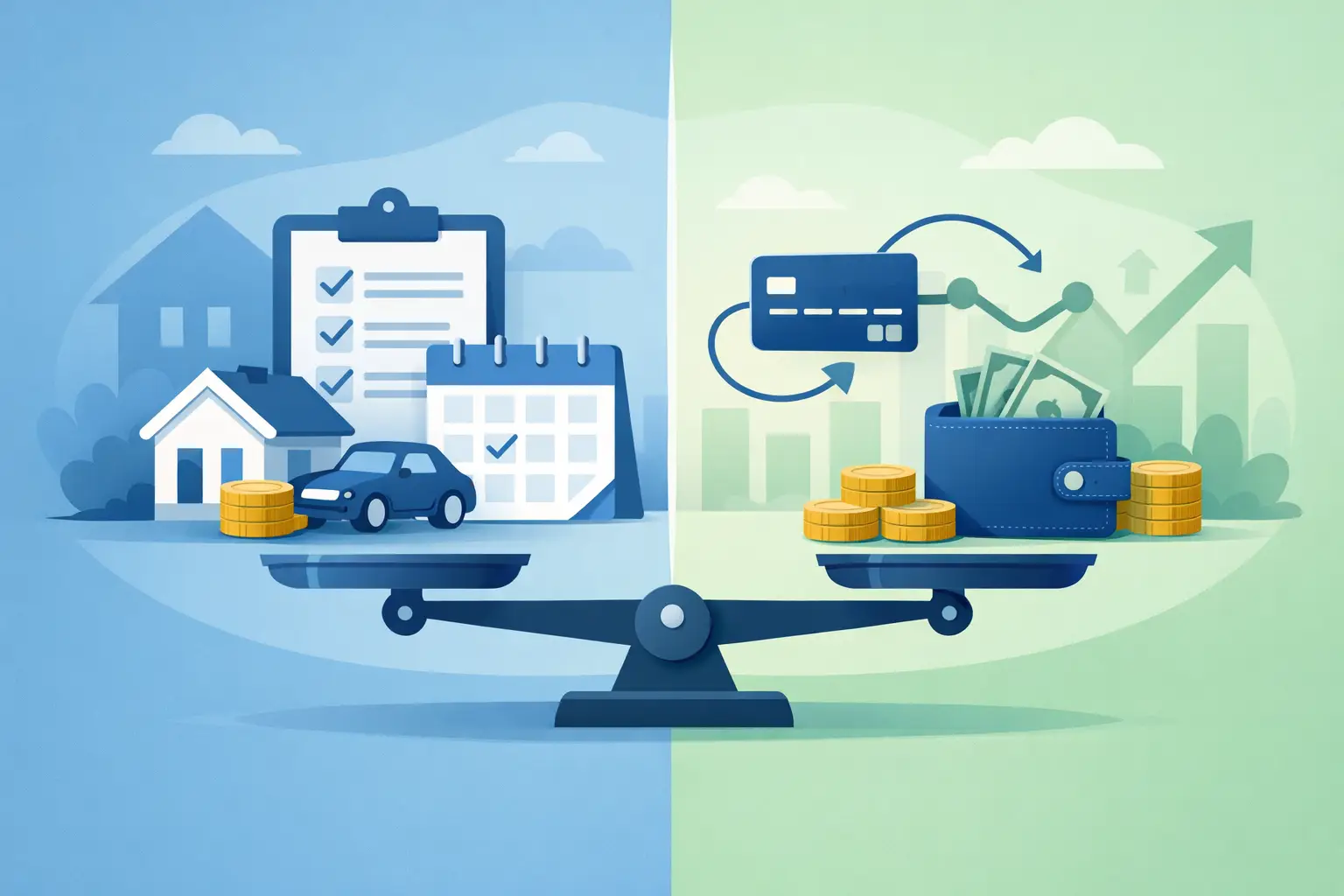
A broken car, a late utility notice, or a medical bill usually does not leave much time to compare financing options for days. If you are weighing an installment loan vs line of credit, the real question is simple: do you need one fixed amount now, or flexible access to money over time?
That difference matters more than most borrowers think. Both options let you borrow money, but they work in very different ways. One gives you a lump sum with predictable payments. The other gives you a borrowing limit you can draw from as needed. If you are trying to cover a short-term gap, catch up on bills, or handle an urgent expense, choosing the wrong one can leave you paying more or scrambling around due dates.
Installment loan vs line of credit: the core difference
An installment loan gives you a set amount of money upfront. You repay it over a fixed term, usually with scheduled monthly payments. The payment amount is often the same each month, which makes it easier to budget. Personal loans are the most common example.
A line of credit works more like a reusable pool of funds. You are approved for a credit limit, but you only borrow what you actually use. If you need more later and still have available credit, you can draw again. Your payment can change based on how much you borrowed and whether you keep using the account.
For many borrowers, that is the biggest deciding factor. If you know exactly how much you need, an installment loan is usually simpler. If your expenses may come in waves or you are not sure of the total yet, a line of credit can offer more flexibility.
When an installment loan makes more sense
An installment loan is often the better fit when the expense has a clear price tag. Think car repairs, rent shortfalls, emergency travel, appliance replacement, or a medical balance you need to pay now. You borrow one amount, receive the funds, and then pay it off on a set schedule.
That fixed structure can be a real advantage when money is tight. You know your due date. You know your payment. You know when the debt should be gone if you stay on track. For borrowers who want less guesswork, that clarity helps.
It can also reduce the temptation to keep borrowing. Once the loan is funded, the account does not usually refill as you make payments. That matters if you are trying to solve one immediate problem without opening the door to ongoing debt.
The trade-off is that installment loans are less flexible after funding. If you borrow too little, you may need to apply again. If you borrow too much, you could end up paying interest on money you did not really need.
When a line of credit may be the better fit
A line of credit can work well when costs are spread out or uncertain. Maybe you are paying for a series of home repairs, covering irregular income gaps, or handling an expense that may grow over a few weeks. Instead of taking one lump sum, you can draw smaller amounts as needed.
That flexibility is the main selling point. You only use part of the limit if that is all you need. In some cases, that means paying interest only on the amount you actually borrowed rather than the full approved amount.
Still, flexibility can cut both ways. Because the account stays open for repeated use, it is easier to rely on it again and again. Payments may also change over time, especially if your balance goes up. For someone already managing a tight budget, that uncertainty can be harder to handle than a fixed loan payment.
Cost is not just about the rate
Borrowers often look at interest first, and that makes sense, but cost is bigger than APR alone. With an installment loan, the rate, fees, payment amount, and repayment term all shape the total cost. A lower payment can feel easier month to month, but a longer term may mean more interest paid over time.
With a line of credit, the cost can be less predictable. Rates may be variable instead of fixed, which means borrowing can get more expensive if rates rise. Some lines of credit also come with annual fees, draw fees, maintenance fees, or penalty charges if payments are missed.
That is why the cheapest-looking option on day one is not always the better deal. You want to know how the product behaves after funding, not just what it promises upfront.
Approval and access to funds
For borrowers facing urgent expenses, speed matters. In practice, both products can offer quick decisions, but installment loans are often easier to understand and faster to use for one-time needs. You apply, review the offer, accept the terms, and receive the funds if approved.
A line of credit can also be fast, but the process may involve more ongoing account management. You still need to request draws after approval, and the amount available can depend on your current balance and account status.
If your goal is to solve a problem today, that difference matters. A fixed loan tends to match the needs of someone who wants one clear funding amount and a straightforward payoff plan. That is one reason platforms like Yup Loans focus on helping borrowers request personal loan options quickly online.
Which one is easier to manage with bad credit?
There is no universal winner here because lenders set their own approval standards. Some borrowers with lower credit scores may find installment loans more available, especially in the small-dollar personal loan space. Others may qualify for a line of credit, but often with lower limits or higher rates.
What matters most is affordability. A product is not helpful just because you qualify for it. If the payments strain your budget from the start, the risk of late fees, overdrafts, and repeat borrowing goes up fast.
If your credit is less than perfect, pay close attention to the full repayment terms, not just the approval message. Ask yourself whether the monthly obligation fits your current income, whether the rate is fixed or variable, and whether there are any fees that could surprise you later.
Installment loan vs line of credit for emergencies
For true emergencies, an installment loan is often the cleaner answer. You know the amount you need, you get the funds, and you start paying it back on a schedule. That simplicity is useful when you are already dealing with stress.
A line of credit can be helpful if the emergency is ongoing or unpredictable. For example, if a repair starts small and may uncover more costs, having room to borrow again can help. But that same flexibility can become a problem if the balance keeps growing without a clear payoff plan.
So the better emergency product depends on the shape of the emergency itself. One bill with one total favors an installment loan. A rolling expense with changing costs may lean toward a line of credit.
Questions to ask before you choose
Before you borrow, slow down long enough to answer a few practical questions. Do you need one fixed amount or access to funds over time? Can you handle a changing payment, or do you need a set monthly amount? Is the rate fixed or variable? Are there fees beyond interest? And most important, what is your plan to pay it off without borrowing again right away?
Those answers usually point to the right product faster than any marketing claim will. A line of credit sounds attractive because it offers flexibility. An installment loan sounds safe because it offers structure. Both can be useful. Both can also get expensive if they do not match the situation.
If your need is immediate, your amount is clear, and your budget would benefit from predictable payments, an installment loan is often the more practical choice. If your costs are uneven and you need room to borrow in stages, a line of credit may be worth considering.
The best borrowing option is not the one with the most features. It is the one that solves the problem in front of you, fits your budget now, and gives you a realistic path to be done with the debt.